
Executive Overview
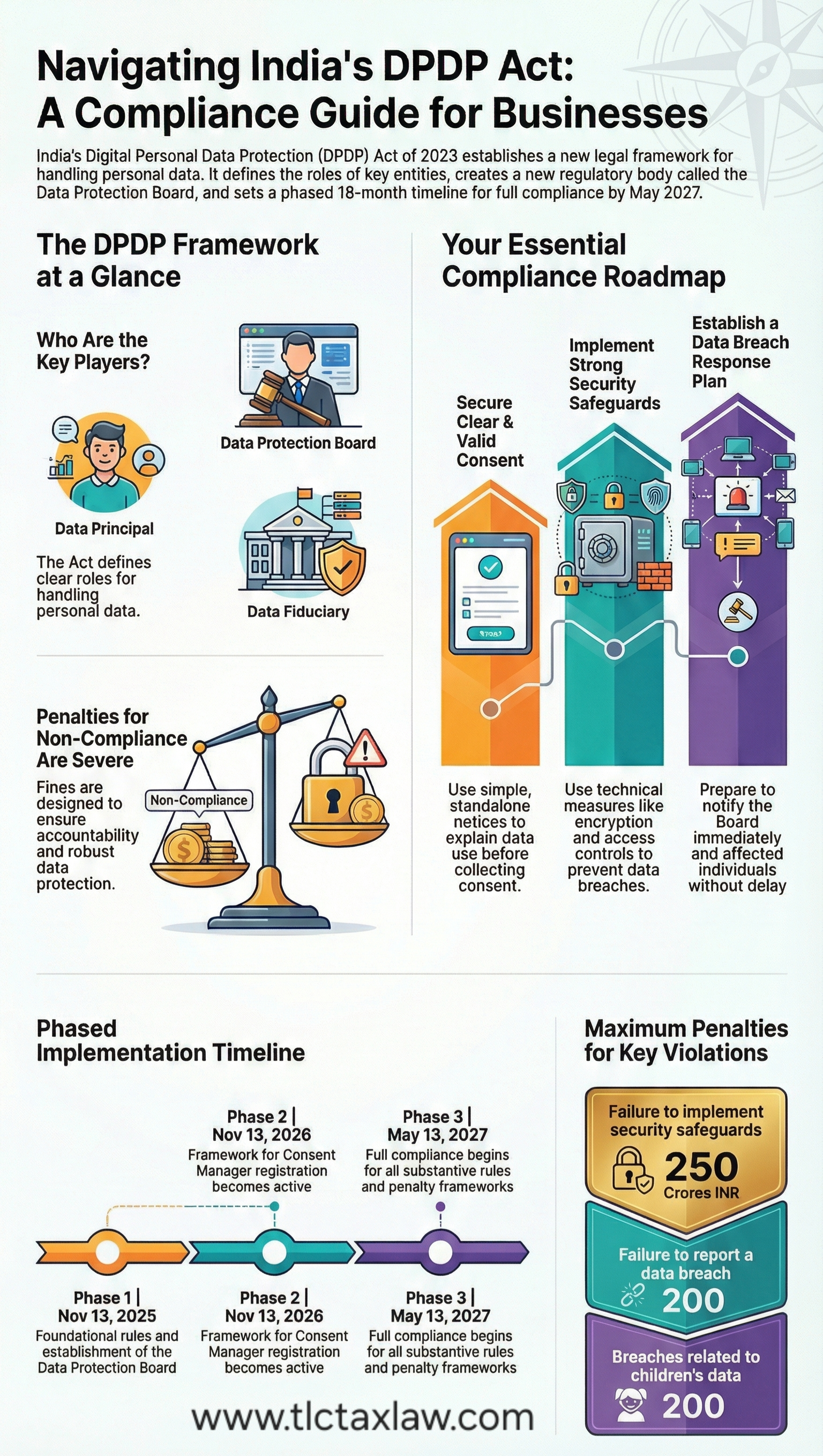
The Digital Personal Data Protection Act, 2023 ("DPDP Act"), operationalised through the Digital Personal Data Protection Rules, 2025 ("DPDP Rules") notified on November 13, 2025, represents a fundamental transformation in India's approach to data governance. This legislative framework establishes binding obligations on how organisations collect, process, store and share personal data, while simultaneously empowering individuals with unprecedented control over their digital information.
The DPDP framework extends beyond traditional privacy legislation by creating an ecosystem approach to data protection. It introduces novel institutional mechanisms such as consent managers, establishes the Data Protection Board of India as an independent statutory regulator, and implements a risk-based compliance model that distinguishes between ordinary data fiduciaries and Significant Data Fiduciaries ("SDFs") based on the scale and sensitivity of their operations.
With an 18-month phased implementation timeline concluding on May 13, 2027, organisations across all sectors must undertake comprehensive operational reforms. This includes redesigning data collection processes, implementing robust security architectures, establishing grievance redressal mechanisms, and creating accountability frameworks that align with the Act's principles of transparency, purpose limitation and data minimisation.
Foundational Architecture and Key Stakeholders
Understanding the Data Ecosystem
The DPDP framework establishes a multi-layered ecosystem with clearly delineated roles and responsibilities:
Data Principal: The individual whose personal data is being processed. This term encompasses natural persons and extends to parents or lawful guardians acting on behalf of children (individuals under 18 years) or persons with disabilities ("PWD") who lack capacity to provide legally binding consent. The Act recognises data principals as rights-holders who exercise control over their personal information through consent mechanisms and statutory rights to access, correction and erasure.
Data Fiduciary: Any entity that determines the purpose and means of processing personal data. This includes corporations, partnerships, proprietorships, non-profit organisations, government departments and public authorities. Data fiduciaries bear primary legal responsibility for compliance with the DPDP Act, including ensuring lawful processing, implementing security safeguards, respecting data principal rights and maintaining accountability for all processing activities conducted directly or through processors.
Data Processor: An entity that processes personal data solely on behalf of a data fiduciary under contractual instructions. Processors do not independently determine processing purposes but must implement security measures, report breaches immediately to the data fiduciary, and ensure compliance with contractual obligations. The distinction between fiduciary and processor is critical for determining liability, with fiduciaries remaining ultimately responsible for processor actions.
Significant Data Fiduciary ("SDF"): Data fiduciaries designated by the central government based on criteria including data volume, sensitivity, potential impact on data principal rights, risks to national security, sovereignty, or electoral democracy. SDFs face enhanced compliance obligations including mandatory appointment of India-based Data Protection Officers ("DPO"), annual independent audits, data protection impact assessments ("DPIA"), algorithmic due diligence and potential data localisation requirements.
Consent Manager: A transformative institutional innovation that serves as an intermediary platform enabling data principals to grant, manage, review and withdraw consent across multiple data fiduciaries through a unified, interoperable interface. Consent managers must register with the Data Protection Board, maintain data-blind operations (unable to view personal data flowing through their platform), operate in a fiduciary capacity toward data principals, and maintain consent records for seven years.
Data Protection Board of India: The independent statutory regulator responsible for enforcement, registration of consent managers, grievance adjudication, penalty imposition and regulatory guidance. The Board operates as a digital-first institution, conducting proceedings through techno-legal tools without requiring physical presence, and exercises quasi-judicial powers to ensure compliance across the data ecosystem.
Phased Implementation Strategy
The DPDP framework's enforcement follows a carefully calibrated three-phase timeline designed to allow organisations adequate preparation time while establishing regulatory infrastructure:
Phase 1 – Foundational Framework (November 13, 2025): This initial phase activates the administrative and institutional foundations. Provisions concerning definitions, the Act's title and commencement become operative. The Data Protection Board is formally established with provisions governing appointment of members, their terms of service, salary structures, meeting procedures and operational protocols taking effect. The Board's function as a digital office is activated, along with the central government's rule-making and transitional powers. This phase establishes the regulatory architecture without imposing substantive compliance obligations on private entities.
Phase 2 – Consent Manager Ecosystem (November 13, 2026): One year into the transition, the consent manager registration framework becomes operational. The Data Protection Board gains authority to verify eligibility of entities seeking consent manager registration, conduct inquiries into non-compliance with registration conditions, and exercise jurisdiction over breaches of consent manager obligations. This phase creates the institutional infrastructure for interoperable consent management while giving organisations additional time to prepare for substantive compliance.
Phase 3 – Full Substantive Compliance (May 13, 2027): Eighteen months from the Rules' notification, all substantive provisions become mandatory and enforceable. This encompasses notice and consent obligations, security safeguards, data principal rights including access and erasure, retention and deletion rules, cross-border transfer regulations, SDF-specific obligations, provisions governing processing for government services, and the complete exemption framework. Critically, the full penalty regime becomes enforceable at this stage, with potential fines reaching INR 250 crores for serious violations.
Transitional Provisions and Existing Framework
During the 18-month transition period, the existing data protection framework under Section 43A of the Information Technology Act, 2000 ("IT Act") and the Information Technology (Reasonable Security Practices and Procedures and Sensitive Personal Data or Information) Rules, 2011 continues to apply. This ensures continuous legal coverage without creating a regulatory vacuum. However, organisations must simultaneously prepare for DPDP compliance, as the existing regime will cease upon full DPDP implementation on May 13, 2027.
Importantly, Section 72A of the IT Act remains independently operative even after DPDP implementation. This provision imposes criminal penalties for unauthorised disclosure of personal data in breach of lawful contracts, ensuring that contractual data protection obligations retain independent legal force beyond the DPDP framework's civil penalty structure.
Lawful Basis for Processing and Consent Architecture
Dual Legal Foundations
The DPDP Act establishes two primary legal bases for processing personal data: consent-based processing and legitimate use processing. Data fiduciaries must identify and document which legal basis justifies each processing activity.
Consent-Based Processing: When processing relies on the data principal's consent, data fiduciaries must obtain free, specific, informed, unconditional and unambiguous consent through clear affirmative action. Consent must be purpose-specific, meaning data fiduciaries cannot obtain blanket consent for undefined future uses. The consent mechanism must be as easily withdrawable as it was to provide initially, ensuring genuine voluntariness.
Legitimate Use Processing: The DPDP Act permits processing without consent for specified legitimate purposes including fulfilling legal obligations, responding to medical emergencies, ensuring network security, complying with court orders or government directives, and processing publicly available data. Each legitimate use category has specific limitations and conditions that data fiduciaries must carefully observe.
Notice Requirements: Transparency as Foundation
Before or at the time of requesting consent, data fiduciaries must provide a notice that serves as the foundation for informed consent. This notice is not merely a formality but a substantive legal requirement with specific content mandates:
Stand-Alone and Clear: The notice must be independent of any other information, such as terms of service, user agreements or product documentation. It cannot be buried within lengthy legal documents but must be presented as a discrete, easily identifiable communication that data principals can review independently.
Plain Language Requirement: Legal jargon, technical terminology and complex sentence structures are prohibited. The notice must be comprehensible to ordinary users without specialised knowledge. Data fiduciaries should test notices with representative user groups to ensure actual comprehension.
Itemised Data Description: The notice must contain a specific, itemised description of the personal data being collected and processed. Generic references like "personal information" or "user data" are insufficient. Instead, data fiduciaries must specify categories such as "name, email address, phone number, location data, transaction history" with sufficient granularity for data principals to understand exactly what information is involved.
Specified Purposes: The notice must clearly articulate the purpose for which personal data will be processed. Vague purposes like "improving services" or "business operations" are inadequate. Instead, purposes must be specific, such as "processing your payment for subscription services," "sending promotional communications about our products," or "analysing usage patterns to enhance application performance."
Goods or Services Description: The notice must explain what goods, services or benefits the data principal will receive in exchange for providing consent. This creates transparency about the value exchange inherent in data processing relationships.
Withdrawal and Rights Information: The notice must include a specific link to the data fiduciary's website or application, along with information on available channels through which data principals can withdraw consent with the same ease as it was originally granted, exercise their statutory rights under the DPDP Act, and file complaints with the Data Protection Board.
Pre-DPDP Act Data: A Practical Challenge
A significant ambiguity concerns personal data collected with consent before the DPDP Act's commencement. The Rules do not explicitly specify how data fiduciaries should provide notices for such legacy data. This creates practical compliance challenges, particularly for organisations with large historical databases.
Until the Ministry of Electronics and Information Technology ("MeitY") issues clarifying guidance, organisations must develop pragmatic mechanisms aligned with the framework's underlying intent. Possible approaches include sending retrospective notices to existing users, implementing notices at next login or interaction, or using consent manager platforms to obtain fresh consent for continued processing. Organisations should document their chosen approach and its rationale to demonstrate good faith compliance efforts.
Enhanced Protections for Vulnerable Groups
Children's Data: Stringent Safeguards
The DPDP framework implements rigorous protections for children's personal data, recognising their heightened vulnerability and the potential for exploitation in digital environments.
Verifiable Parental Consent: Before processing any child's personal data, data fiduciaries must obtain verifiable consent from a parent or lawful guardian. This goes beyond merely asking whether the user is over 18—it requires affirmative verification mechanisms. Acceptable verification methods include using reliable identity and age details already maintained by the data fiduciary in normal course of business, voluntarily provided details from parents/guardians, or virtual tokens issued or verified by authorised entities such as digital locker service providers linked to government identity systems.
Prohibited Processing Activities: Data fiduciaries are absolutely prohibited from engaging in tracking or behavioural monitoring of children, creating behavioural profiles based on their activities, or directing targeted advertisements at children. These prohibitions recognise the manipulative potential of surveillance-based advertising and the need to protect children's developmental autonomy from commercial exploitation.
Well-Being Standard: Beyond specific prohibitions, data fiduciaries must ensure that processing is not detrimental to the child's well-being. This creates an affirmative obligation to assess potential harms including psychological impacts, exploitation risks, developmental interference and privacy violations. The well-being standard requires ongoing assessment rather than one-time determination.
Exemptions for Specific Purposes: Recognising legitimate organisational needs, the DPDP Rules exempt certain classes of data fiduciaries from specific restrictions when processing serves defined purposes. Educational institutions, clinical establishments and childcare centres can track children's real-time location for safety, protection and security purposes. Healthcare providers can process health data for treatment. These exemptions are narrowly constructed and purpose-limited, not blanket authorisations.
Persons with Disabilities: Capacity-Based Approach
The DPDP framework adopts a nuanced approach to PWD data protection, balancing protection with autonomy and avoiding paternalistic assumptions.
Guardian Consent Requirement: Data fiduciaries must obtain verifiable consent from the PWD's lawful guardian only when the PWD is unable to make legally binding decisions despite adequate support. This capacity-based approach respects PWD autonomy while providing protection where needed.
Rigorous Due Diligence: Unlike parental consent for children, guardian consent for PWD requires affirmative due diligence. Data fiduciaries must verify that the guardian was formally appointed by a competent court, a designated authority under the Rights of Persons with Disabilities Act, 2016, or a local committee under the National Trust for the Welfare of Persons with Autism, Cerebral Palsy, Mental Retardation and Multiple Disabilities Act, 1999. Documentary evidence of formal appointment must be obtained and verified.
Critical Distinction: The Rules create an important distinction between verification requirements for children versus PWD. For children, data fiduciaries need not independently verify whether the person providing consent is actually the parent or guardian—they can rely on representations made by the consenting adult. However, for PWD, affirmative verification of guardianship appointment is mandatory. This reflects the heightened risk of exploitation and the need to ensure legitimate guardianship relationships.
Security Safeguards: Building Resilient Systems
Risk-Based Security Framework
The DPDP Act mandates that data fiduciaries and data processors implement reasonable security safeguards commensurate with the nature, volume and sensitivity of personal data being processed. This risk-based approach recognises that security measures must be proportionate and context-appropriate rather than one-size-fits-all.
Technical Measures: Data fiduciaries must deploy technological protections appropriate to their processing activities. The Rules specifically reference encryption (rendering data unreadable without decryption keys), masking (replacing sensitive portions with non-sensitive equivalents), obfuscation (making data deliberately difficult to understand), and tokenisation (substituting sensitive data with non-sensitive virtual tokens mapped to the original data). The choice among these techniques depends on the specific use case, with stronger protections required for more sensitive data categories.
Access Controls: Computer resources used for processing personal data must be protected through access control mechanisms. This includes implementing role-based access controls that limit data access to personnel with legitimate business needs, authentication mechanisms to verify user identities, authorisation systems to enforce permission structures, and audit capabilities to track who accessed what data when. Access controls should extend throughout the data lifecycle including storage, transmission and processing phases.
Monitoring and Logging: Data fiduciaries must implement systems to detect unauthorised access attempts, log all access and processing activities, investigate security incidents, and implement remediation measures to prevent recurrence. Logging should capture sufficient detail to reconstruct security incidents while respecting privacy principles by limiting collection of personal data in logs themselves. Log retention must comply with the mandatory one-year minimum retention requirement.
Resilience and Business Continuity: Security safeguards extend beyond preventing breaches to ensuring continued processing capability in case of data loss, system failures or disasters. This requires implementing backup systems, disaster recovery plans, redundant infrastructure where appropriate, and regular testing of continuity procedures. The goal is ensuring that personal data remains available and processing operations can continue even during adverse events.
Contractual Controls: When data fiduciaries engage data processors, contracts must explicitly mandate security safeguards. The data fiduciary must provide clear instructions on required security measures, and processors must contractually commit to implementing and maintaining these protections. Processors should also commit to immediate breach notification and allow data fiduciaries to audit processor security practices.
Security as Proportionate and Evolving
The indicative nature of the specified security measures recognises that appropriate safeguards vary based on processing context. A fintech platform processing sensitive financial data requires more stringent controls than an e-commerce site collecting delivery addresses. Similarly, security measures must evolve as threats emerge, technologies advance and processing activities change. Data fiduciaries should conduct periodic security assessments to ensure controls remain adequate.
Data Lifecycle Management: Retention and Erasure
General Deletion Principle
The DPDP framework establishes data minimisation as a core principle, requiring deletion of personal data when the specified processing purpose is no longer being served or when consent is withdrawn, whichever occurs earlier. This prevents indefinite data retention and reduces exposure to security risks, privacy violations and compliance costs.
Data fiduciaries must actively monitor whether processing purposes remain active. Once a purpose is fulfilled—such as when a service contract ends, a transaction is completed, or a business relationship terminates—data fiduciaries must delete personal data unless a specific legal basis mandates continued retention.
Similarly, when data principals withdraw consent, processing must cease and data must be deleted unless the data fiduciary can identify an alternative legal basis such as a legal obligation to retain records or a legitimate use exception. The burden of justifying continued retention rests on the data fiduciary.
Mandatory Minimum Retention: The Sovereign Use Requirement Creating significant complexity, the DPDP Rules impose a mandatory minimum retention obligation alongside the general deletion principle. Data fiduciaries must retain personal data, traffic data and processing logs for at least one year from the date of processing for purposes specified in the Seventh Schedule of the DPDP Rules.
These purposes relate to sovereign uses by the state and its instrumentalities, including processing for national security and sovereignty, performing functions under Indian law, and disclosing information pursuant to legal requirements. The mandatory one-year retention ensures that government authorities can access historical data for security, investigative and regulatory purposes even after processing purposes are fulfilled or consent is withdrawn.
This creates an inherent tension: data must be deleted when no longer needed for specified purposes or when consent is withdrawn, yet must simultaneously be retained for one year for potential sovereign use. In practice, this means organisations cannot delete data immediately upon purpose completion or consent withdrawal if less than one year has elapsed since processing. The sovereign use retention requirement effectively overrides the general deletion principle during this one-year period.
Sector-Specific Extended Retention
For certain data fiduciaries identified in the Third Schedule of the DPDP Rules, extended retention periods apply. E-commerce entities, social media intermediaries with 20 million or more registered users, and online gaming intermediaries with 5 million or more registered users must retain data for a maximum of three years from the later of the data principal's last contact for the specified purpose or the commencement of the DPDP Rules.
These Third Schedule entities must provide data principals with at least 48 hours' advance notice before erasing data, informing them that data will be deleted unless they log in, contact the data fiduciary, or exercise their rights. This pre-deletion notice allows data principals to preserve data or exercise rights before deletion becomes irreversible.
Implementing Retention Policies
Data fiduciaries should establish clear retention schedules specifying how long different categories of personal data will be retained based on processing purposes and applicable legal requirements. These schedules should account for the general deletion principle, mandatory minimum retention requirements, sector-specific rules, and any retention mandates under other applicable laws.
Technical systems should automate retention enforcement where possible, flagging data for review when retention periods expire and implementing secure deletion procedures that render data irretrievable. Deletion must be comprehensive, covering primary databases, backup systems, archived data, logs and any other repositories where personal data resides.
Personal Data Breach Management
Defining Personal Data Breach
The DPDP Rules define a personal data breach as any unauthorised processing of personal data, or any accidental disclosure, acquisition, sharing, use, alteration, destruction or loss of access to personal data, that compromises the confidentiality, integrity or availability of personal data. This definition is deliberately broad, capturing both malicious incidents (hacking, theft) and accidental events (misconfigured databases, misdirected emails, inadvertent disclosures).
Confidentiality Breach: Occurs when personal data is disclosed to unauthorised parties, whether through hacking, insider threats, misconfigured systems, or other means. Examples include ransomware attacks encrypting data and demanding payment, unauthorised employee access to customer records, or publicly exposed databases due to security misconfigurations.
Integrity Breach: Happens when personal data is unauthorisedly modified, corrupted or altered, compromising its accuracy and reliability. This could include malicious modification of records, data corruption due to system failures, or unauthorised updates to customer profiles.
Availability Breach: Results from loss of access to personal data, whether through destructive attacks, system failures, denial of service incidents or other events preventing authorised access. Even if data remains confidential and unmodified, inability to access it when needed constitutes a breach.
Dual Notification Obligation
Upon discovering a personal data breach, data fiduciaries face immediate notification obligations to both affected data principals and the Data Protection Board.
Notification to Affected Data Principals: Data fiduciaries must notify each affected data principal without delay. The notification must contain a clear description of the breach including its nature, extent and timing, an explanation of what happened, an assessment of likely consequences to the affected individual, details of mitigation steps taken by the data fiduciary, protective actions the individual should take to minimise harm, and business contact details for queries.
This notification serves multiple purposes: it empowers individuals to take protective actions such as changing passwords, monitoring accounts for fraud or taking legal steps; it demonstrates transparency and respect for data principal rights; and it creates accountability by making breaches visible rather than allowing organisations to conceal incidents.
Initial Report to Data Protection Board: Immediately upon becoming aware of a breach, data fiduciaries must provide an initial report to the Data Protection Board. This expedited reporting enables the Board to assess breach severity, monitor systemic risks, and provide guidance or intervention if necessary. The initial report should include the nature, extent, timing, location and likely impact of the breach based on information available at the time of reporting.
Detailed Report to Data Protection Board: Within 72 hours of breach discovery (with possible extensions for justified reasons), data fiduciaries must submit a detailed report containing updated and comprehensive information. This includes complete facts and circumstances surrounding the breach, root causes and contributing factors, findings on who or what caused the breach, mitigation measures already implemented, remedial actions to prevent recurrence, and confirmation that affected individuals have been notified.
The detailed report requirement ensures thorough breach investigation and documentation, creating accountability and enabling the Board to assess whether data fiduciaries responded appropriately. Extensions beyond 72 hours may be granted when investigations are genuinely complex, but data fiduciaries must justify extension requests.
Processor Breach Reporting
When a breach occurs at a data processor, the processor must immediately inform the data fiduciary. The processor does not directly notify data principals or the Data Protection Board—these obligations rest with the data fiduciary. However, processors must provide data fiduciaries with complete and timely information about the breach to enable the data fiduciary to fulfill its notification obligations.
This allocation of responsibility reflects the data fiduciary's ultimate accountability for all processing activities, even those performed by processors on the fiduciary's behalf. Contracts with processors should specify breach notification procedures, required information, notification timelines and responsibilities.
Preparing for Breach Response
Given the immediate notification requirements, data fiduciaries must establish breach response plans before incidents occur. These plans should identify the breach response team including technical personnel, legal counsel, communications staff and senior management; define breach detection mechanisms and monitoring systems; establish investigation procedures to determine breach scope, cause and impact; create notification templates and communication channels; designate responsibility for Data Protection Board reporting; and conduct regular breach response drills to test procedures.
The mandatory 72-hour detailed reporting deadline leaves little time for ad hoc response. Only organisations with pre-established response frameworks can meet these demanding timelines while ensuring thorough investigation and appropriate communication.
Data Principal Rights and Empowerment
Rights Framework
The DPDP Act creates a comprehensive rights framework empowering data principals to control their personal data and hold data fiduciaries accountable.
Right to Access: Data principals can request a summary of their personal data being processed, including the categories of data, processing purposes, recipients of data, and retention periods. This transparency right enables individuals to understand what data organisations hold about them and how it is used.
Right to Correction and Updation: When personal data is inaccurate, incomplete or outdated, data principals can request correction or updation. Data fiduciaries must have procedures to verify correction requests, update data across all systems where it resides, and notify any recipients of the data about corrections when feasible.
Right to Erasure: Data principals can request deletion of their personal data when processing purposes are fulfilled, consent is withdrawn, or retention is no longer justified. Data fiduciaries must comply unless legal obligations mandate continued retention. The right to erasure creates a privacy safety valve allowing individuals to sever data relationships when desired.
Right to Grievance Redressal: When data principals believe their rights have been violated or have concerns about processing activities, they can file grievances with the data fiduciary. Data fiduciaries must establish grievance redressal mechanisms, publish clear procedures for filing grievances, and resolve complaints within 90 days from receipt.
Right to Nominate: Data principals can nominate one or more individuals to exercise their rights in case of death or incapacity. This ensures that data rights survive the data principal and can be enforced by designated representatives, providing continuity of privacy protection.
Operational Implementation
Data fiduciaries must publish clear, accessible information on their websites and applications explaining how data principals can exercise their rights. This includes providing specific contact details for the Data Protection Officer (if applicable) or an authorised person who can answer questions about personal data processing.
Rights request procedures must be user-friendly, not requiring legal knowledge or technical expertise. Data fiduciaries should offer multiple channels for submitting requests such as web forms, email addresses, postal mail or in-app mechanisms. Response times should be clearly communicated, and data fiduciaries must acknowledge receipt of requests promptly.
The 90-day grievance resolution deadline is a maximum, not a target. Data fiduciaries should resolve straightforward grievances much faster, reserving the full 90 days only for genuinely complex matters requiring investigation, consultation or system modifications.
Significant Data Fiduciary Obligations
SDF Designation
The central government designates certain data fiduciaries as "Significant" based on factors including the volume and sensitivity of personal data processed, the potential risk to data principal rights, impacts on national security, sovereignty or public order, and effects on electoral democracy. SDF designation reflects recognition that large-scale or high-risk processing requires enhanced safeguards and oversight.
Designation criteria are not mathematically precise, allowing government discretion to designate based on holistic assessment. Large technology platforms, telecommunications providers, financial institutions, healthcare data aggregators and government-facing intermediaries are likely SDF candidates given their data scale and societal impact.
Enhanced Obligations
SDFs face significantly heightened compliance requirements beyond those applicable to ordinary data fiduciaries:
Data Protection Officer Appointment: SDFs must appoint a Data Protection Officer based in India. The India-based requirement ensures regulatory accessibility and accountability. The DPO serves as the primary point of contact with the Data Protection Board, oversees internal compliance, coordinates breach response, handles data principal inquiries and generally champions privacy within the organisation. The DPO must have sufficient seniority, independence and resources to effectively fulfill these responsibilities.
Annual Data Protection Impact Assessment: SDFs must conduct comprehensive DPIAs annually to identify, assess and mitigate privacy risks associated with their processing activities. DPIAs should evaluate necessity and proportionality of processing, identify potential harms to data principals, assess security measures, consider compliance with DPDP principles, and document mitigation strategies. DPIAs create proactive risk management frameworks requiring SDFs to continuously assess and improve their privacy posture.
Independent Audit: SDFs must commission independent audits of their data protection practices annually. Auditors must be genuinely independent, free from conflicts of interest, and possess appropriate technical and legal expertise. Critically, auditors must submit key observations directly to the Data Protection Board, creating transparency and independent accountability. Audit findings should cover compliance with security requirements, effectiveness of data principal rights mechanisms, adequacy of breach response procedures, processor oversight and general DPDP compliance.
Algorithmic Due Diligence: SDFs must verify that technical measures and algorithmic systems used for processing personal data are designed and operated to safeguard data principal rights. This obligation addresses growing concerns about automated decision-making, profiling, recommendation systems and artificial intelligence applications. SDFs must assess whether algorithms create discriminatory outcomes, violate privacy principles, manipulate user behaviour or create other risks to data principals. Algorithmic due diligence should include bias testing, explainability assessments, impact evaluations and ongoing monitoring.
Data Localisation: SDFs must ensure that government-designated categories of personal data and related traffic data are not transferred outside India. While the government has not yet designated specific data categories for localisation, this power creates potential for future localisation mandates. SDFs should prepare infrastructure and processes to implement localisation requirements if designated categories are announced.
Strategic Implications
SDF designation creates substantial compliance costs and operational complexity. Organisations should assess whether they might be designated and begin preparing enhanced compliance frameworks. However, designation also confers certain reputational benefits by signaling scale and importance within the digital economy.
Consent Managers: Institutional Innovation
Conceptual Foundation
Consent managers represent a novel institutional mechanism designed to address power asymmetries in digital consent relationships. Traditionally, data principals provide consent to each data fiduciary individually through that fiduciary's interface, creating fragmented consent management, information asymmetry, difficulty tracking and withdrawing consents, and inability to exercise meaningful control when consents proliferate across dozens or hundreds of services.
Consent managers solve these problems by creating centralised, interoperable platforms where data principals can grant, monitor, review and withdraw consents across multiple data fiduciaries through a unified interface. This transforms consent from individual, bilateral transactions into a managed ecosystem with data principal empowerment at its centre.
Operational Model
Consent managers serve as trusted intermediaries between data principals and data fiduciaries. A data principal registers with a consent manager and uses its platform to grant consents when data fiduciaries seek to process personal data. The consent manager communicates consent decisions to data fiduciaries either directly or through intermediary data fiduciaries onboarded on the platform.
Critically, consent managers operate as data-blind platforms—they cannot view or access the personal data being exchanged through their platform. They manage only consent metadata (what consent was granted, to whom, for what purpose, when granted, when withdrawn) not the underlying personal data. This data-blind architecture ensures consent managers cannot themselves become privacy risks.
Consent managers operate in a fiduciary capacity toward data principals, meaning they must act in data principals' best interests, maintain loyalty, avoid conflicts of interest and prioritise data principal welfare over commercial considerations. This fiduciary obligation distinguishes consent managers from ordinary commercial platforms and creates heightened duties of care.
Registration and Governance Requirements
Consent managers must register with the Data Protection Board to operate legally. Registration requirements include incorporation in India, maintaining net worth above INR 2 crores (20 million), demonstrating technical capability to operate data-blind interoperable platforms, establishing governance structures that avoid conflicts of interest with data fiduciaries, particularly regarding directors or key managerial personnel having overlapping roles, committing to retain consent records for at least seven years, and implementing strong audit mechanisms with outcomes reported to the Data Protection Board when required.
These stringent requirements ensure that only well-capitalised, technically competent and ethically governed entities can operate as consent managers. The registration framework balances innovation and entry opportunities with the need for institutional quality and trustworthiness.
Practical Adoption Challenges
While conceptually powerful, consent manager adoption faces practical challenges. Data fiduciaries must integrate consent manager APIs into their systems, potentially requiring significant technical investment. Network effects mean consent managers become valuable only when many data fiduciaries and data principals participate, creating chicken-and-egg adoption challenges. Cultural change is needed for data principals to embrace centralised consent management rather than continuing fragmented practices. Standardisation across consent managers is necessary to ensure genuine interoperability.
Successful consent manager adoption likely requires industry coordination, government promotion and demonstration of clear value to both data principals (simplified consent management) and data fiduciaries (standardised consent infrastructure, regulatory compliance).
Cross-Border Data Transfers
Principle and Restrictions
The DPDP Act permits cross-border transfer of personal data, but subjects such transfers to requirements, restrictions and conditions specified by the central government through general or special orders. This creates a flexible regulatory framework allowing government to impose transfer restrictions based on evolving geopolitical, security and privacy considerations.
The government may impose conditions related to transfers to specific foreign states, transfers to entities under control of foreign state agencies, transfers of specific categories of sensitive data, security and privacy safeguards required for international transfers, or contractual requirements with foreign recipients. These conditions could range from adequacy assessments (requiring recipient countries to have comparable data protection laws) to specific authorisation requirements, contractual standard clauses or prohibitions on transfers to certain jurisdictions.
SDF Localisation
For SDFs specifically, the government may designate categories of personal data that must not be transferred outside India. While no categories have been designated yet, this power creates potential for future localisation mandates particularly for sensitive data related to national security, financial systems, healthcare, critical infrastructure or other strategic domains.
SDFs should prepare for potential localisation by assessing which data categories might be designated, evaluating their current data storage and processing geography, identifying overseas transfers that might be prohibited, and developing technical capabilities to implement localisation requirements if mandated.
Strategic Planning
Given regulatory uncertainty around cross-border transfers, data fiduciaries should map their current international data flows, identify business dependencies on cross-border transfers, assess potential impact of transfer restrictions, develop contingency plans for localisation scenarios, and implement contractual safeguards with foreign processors or recipients to ensure appropriate data protection standards apply internationally.
Government Access Framework
Sovereign Access Powers
The DPDP Rules reinforce the central government's authority to request information from data fiduciaries and intermediaries for specified sovereign purposes including national security, sovereignty and integrity of India, performance of functions under applicable Indian law, and disclosure pursuant to legal requirements. These government access powers reflect the state's legitimate need to access data for security, regulatory and law enforcement purposes.
Government access requests must be properly authorised through specified procedures ensuring appropriate oversight and preventing arbitrary or unauthorised access. Data fiduciaries should establish procedures for receiving, verifying authenticity, assessing legal validity, and responding to government data requests.
Non-Disclosure Requirements
Critically, if disclosing the fact that information was furnished to government could jeopardise India's sovereignty or security, data fiduciaries are prohibited from disclosing this fact to affected data principals or any other person without prior written consent from the authorised requesting personnel. This non-disclosure requirement balances transparency with security imperatives in sensitive investigations.
The non-disclosure requirement creates tension with the general principle of transparency and data principal rights to know how their data is processed. However, it reflects recognition that in genuine security contexts, disclosure could compromise investigations, enable suspects to destroy evidence or take evasive action, or otherwise harm national security interests.
Exemptions and Special Provisions
Institutional Exemptions
The DPDP Rules carve out specific exemptions recognising that certain institutional contexts require flexibility from standard restrictions:
Healthcare Providers and Clinical Establishments: Restrictions on tracking or monitoring children do not apply when such activities are necessary for delivering healthcare services, clinical treatment, health monitoring or related medical purposes. This ensures that legitimate healthcare activities are not impeded while maintaining protection against commercial exploitation.
Educational Institutions: Schools, colleges and educational bodies can track or monitor children when necessary for educational functions, student safety, academic assessment or related educational purposes. The exemption recognises schools' legitimate need to supervise students while prohibiting commercial tracking or behavioural profiling.
Childcare Centres and Creches: These facilities can track children's real-time location and monitor activities for safety, protection and security purposes. The exemption reflects the unique duty of care these institutions owe to children under their supervision.
Research, Archival and Statistical Exemptions
Processing undertaken exclusively for research, archival or statistical purposes can qualify for exemptions from certain DPDP requirements, provided such processing is non-commercial in nature, incorporates suitable privacy protections including anonymisation or pseudonymisation where appropriate, and satisfies prescribed conditions ensuring processing serves genuine research or public interest objectives rather than commercial exploitation.
These exemptions recognise the societal value of research and statistical analysis while ensuring that commercial entities cannot exploit research exemptions as loopholes for unregulated data processing. The non-commercial requirement is critical—purely academic, governmental or non-profit research may qualify, while commercial market research or product development typically would not.
Comprehensive Compliance Roadmap
Organisational Assessment and Gap Analysis
The first critical step toward DPDP compliance is conducting a comprehensive assessment of current data practices against DPDP requirements. This assessment should encompass all organisational functions touching personal data.
Data Mapping Exercise: Organisations must create a complete inventory of all personal data collected, processed, stored or shared. This inventory should identify data categories (contact information, financial data, health data, location data, behavioural data), processing purposes for each category, legal basis for processing (consent or legitimate use), data sources and collection methods, storage locations including databases, cloud services, backup systems, data flows within the organisation and to third parties, data recipients including processors, service providers, business partners, retention periods currently applied, and security measures protecting each data category.
This data mapping serves as the foundation for all compliance activities, enabling organisations to identify gaps between current practices and DPDP requirements, prioritise remediation efforts based on risk and sensitivity, document compliance efforts for regulatory accountability, and respond efficiently to data principal rights requests.
Legal Basis Assessment: For each processing activity identified in the data mapping, organisations must determine whether valid legal basis exists under the DPDP framework. Is processing based on data principal consent? If so, does that consent meet DPDP standards (specific, informed, freely given, easily withdrawable)? Does processing qualify for a legitimate use exemption? If so, are the conditions for that exemption satisfied? Where valid legal basis is unclear or absent, what remediation is required?
Consent Audit: Organisations relying on consent must audit existing consent mechanisms against DPDP standards. Are notices clear, stand-alone and written in plain language? Do notices contain all required elements including itemised data descriptions, specific purposes, and rights information? Is consent obtained through clear affirmative action or through problematic methods like pre-ticked boxes or inferred consent? Can data principals withdraw consent as easily as they granted it? Are consent records properly documented and accessible?
Where current consent mechanisms are deficient, organisations must redesign consent flows, create compliant notice templates, implement technical mechanisms for granular consent collection and withdrawal, and consider whether fresh consent is required for ongoing processing.
Security Assessment: Organisations must evaluate whether current security measures meet DPDP standards. Are technical safeguards commensurate with data sensitivity and processing risks? Are access controls implemented based on principle of least privilege? Are monitoring and logging systems adequate to detect and investigate breaches? Are resilience and continuity measures sufficient to ensure processing continuity during adverse events? Do contracts with processors mandate adequate security measures?
Security gaps should be prioritised based on data sensitivity and breach risk, with critical vulnerabilities requiring immediate remediation and lower-risk issues addressed according to phased implementation timelines.
Children and Vulnerable Group Compliance
Organisations processing children's data or PWD data must implement specialised compliance measures.
Age Verification Mechanisms: Organisations must implement reliable methods to identify when users are children requiring parental consent. Age verification approaches might include requiring government-issued identity documents, using digital identity verification services, implementing age estimation technologies (with appropriate accuracy validation), maintaining existing reliable age data from prior interactions, or accepting voluntary age declarations with appropriate validation.
The verification approach should be proportionate to processing risks—high-risk processing of sensitive child data requires more rigorous verification than low-risk processing of basic contact information.
Parental Consent Workflow: Once a child is identified, organisations must establish workflows to obtain and verify parental consent. This might involve collecting parent contact information, sending consent requests directly to parents via email or SMS, implementing verification that the person providing consent is actually a parent or guardian (though rigorous verification is not mandated for parents as it is for PWD guardians), documenting parental consent with appropriate audit trails, and enabling parents to withdraw consent or exercise rights on the child's behalf.
Prohibited Activities Compliance: Organisations must ensure they do not engage in tracking or monitoring children's behaviour, creating behavioural profiles based on children's activities, or directing targeted advertisements at children. Technical systems, advertising platforms and analytics tools must be configured to exclude children from tracking and targeting. Age segregation in user databases may be necessary to ensure children are systematically excluded from prohibited processing.
PWD Guardianship Verification: For PWD who cannot provide legally binding consent, organisations must implement due diligence procedures to verify lawful guardianship. This requires collecting documentation proving formal appointment by competent authorities, verifying authenticity of guardianship documents, confirming the guardian's authority scope and duration, and documenting the verification process for audit purposes.
Notice and Consent Redesign
Achieving DPDP-compliant consent requires comprehensive redesign of user interfaces, legal communications and backend systems.
Notice Template Development: Organisations should create standardised notice templates covering common processing scenarios. Each template must be written in plain language, structured as standalone documents independent of terms of service or other agreements, contain itemised data descriptions rather than generic categories, specify concrete purposes rather than vague business objectives, and include all mandatory elements such as links to rights exercise mechanisms and Data Protection Board complaint procedures.
Templates should be tested with representative user groups to ensure actual comprehension, with revisions based on user feedback. Multiple language versions may be necessary for diverse user populations.
User Interface Modifications: Consent collection interfaces must be redesigned to ensure notices are prominently displayed, consent requests are specific to identified purposes rather than bundled, affirmative action (such as clicking "I consent") is required rather than inferred consent, consent is not conditioned on acceptance of unrelated terms, and withdrawal mechanisms are as accessible as consent grant mechanisms.
Mobile applications, websites and other digital touchpoints must all be reviewed and modified to meet these standards. Legacy systems may require significant technical investment to implement granular consent management.
Consent Management Infrastructure: Backend systems must support granular consent recording, storage and retrieval. This includes maintaining records of what consent was granted, when it was granted, what notice was provided, for what purposes consent was given, when consent was withdrawn (if applicable), and documentation supporting consent validity.
Consent records must be readily accessible to respond to regulatory inquiries, data principal rights requests and internal compliance audits. Integration with consent manager platforms may provide standardised infrastructure for consent management.
Security Implementation
Achieving reasonable security safeguards requires both technical implementations and organisational controls.
Encryption Deployment: Personal data should be encrypted both at rest (when stored in databases, file systems or backup media) and in transit (when transmitted over networks). Encryption strength should be appropriate to data sensitivity, with stronger algorithms and key lengths for highly sensitive data. Key management practices must ensure encryption keys are securely generated, stored separately from encrypted data, regularly rotated and available only to authorised personnel.
Access Control Implementation: Technical access controls must enforce the principle of least privilege, granting users access only to data necessary for their job functions. This requires implementing role-based access control systems that define user roles and associated permissions, authentication mechanisms ensuring only authorised users access systems, authorisation checks validating permissions before granting data access, and audit logging tracking all access to personal data.
Administrative access should be particularly restricted, with privileged accounts subject to enhanced security measures including multi-factor authentication, enhanced logging and monitoring, and regular review of privileged access grants.
Monitoring and Logging Systems: Organisations must deploy security information and event management (SIEM) systems or equivalent monitoring tools that aggregate logs from multiple systems, detect anomalous access patterns or potential breaches, generate alerts for security personnel, and support investigation of security incidents.
Logs should capture user identity, accessed data, access timestamp, actions performed (read, modify, delete), and access context (location, device, application). Log retention must meet the mandatory one-year minimum requirement and may need to be longer based on other legal obligations or security best practices.
Incident Response Preparation: Given the immediate breach notification requirements, organisations must establish formal incident response plans before breaches occur. These plans should designate an incident response team including technical security personnel, legal counsel, communications staff and senior management; define breach detection and escalation procedures; establish investigation protocols to determine breach scope, cause and impact; create notification templates for data principals and Data Protection Board; designate specific individuals responsible for Board reporting; and include procedures for post-incident remediation and lessons learned.
Regular incident response drills and tabletop exercises should test these procedures, identifying gaps and ensuring the team can execute effectively under the pressure of an actual breach.
Data Retention Policy Development
Organisations must develop and implement comprehensive data retention policies reconciling the competing requirements of purpose-based deletion, mandatory minimum retention and sector-specific rules.
Retention Schedule Creation: For each category of personal data and processing purpose, organisations should document the applicable retention period based on how long the purpose remains active, mandatory minimum one-year retention for sovereign use, sector-specific retention rules (three years for Third Schedule entities), and any additional retention required under other applicable laws.
The retention schedule should be granular enough to enable automated enforcement while avoiding excessive complexity. Categories might be organised by data type (customer data, employee data, transaction data), processing purpose (service delivery, marketing, compliance), or legal obligation (tax records, employment records, transaction history).
Automated Retention Enforcement: Technical systems should automate retention enforcement where possible, flagging data approaching retention period expiration, triggering review workflows to assess whether continued retention is justified, automatically deleting data where retention periods have expired and no extension basis exists, and documenting deletion with audit trails for compliance evidence.
Manual processes may be necessary for complex retention decisions requiring legal judgment, but routine deletion should be automated to ensure consistent enforcement and reduce compliance burden.
Secure Deletion Procedures: Deletion must render data irretrievable rather than merely removing it from production systems while leaving it in backups, archives or logs. Secure deletion procedures should cover all data repositories including production databases, backup systems, archived data, system logs, and any other locations where personal data might reside.
Technical deletion methods might include cryptographic erasure (destroying encryption keys rendering encrypted data irretrievable), physical destruction of storage media for highly sensitive data, and multi-pass overwriting to prevent data recovery from deleted storage blocks. Documentation of deletion with appropriate audit trails supports compliance evidence.
Data Principal Rights Implementation
Enabling data principal rights exercise requires establishing accessible request mechanisms, internal workflow processes and technical capabilities.
Rights Request Portal: Organisations should create user-friendly mechanisms for data principals to exercise rights. This might include dedicated web forms for rights requests, email addresses monitored by responsible personnel, in-application request mechanisms for mobile apps, postal mail options for users preferring non-digital communication, and phone support for users requiring assistance.
Request mechanisms should be easily discoverable, clearly explained with plain language guidance on what each right entails, and accessible without requiring legal knowledge or technical expertise.
Internal Request Workflow: Upon receiving a rights request, organisations must have defined processes for request intake and acknowledgment, identity verification to prevent unauthorised access to personal data, request routing to appropriate personnel based on request type, data gathering to locate all relevant personal data, legal review to assess whether exceptions or limitations apply, response preparation communicating outcomes to data principals, and response delivery within statutory timelines.
For access requests, organisations must compile comprehensive summaries of personal data being processed. For correction requests, verification and updating procedures ensure accuracy. For erasure requests, assessment of whether legal basis for continued retention exists must precede deletion. For grievances, investigation and remediation processes address data principal concerns.
Technical Capabilities: Backend systems must support rights exercise including search and retrieval capabilities to locate all personal data related to a data principal across multiple systems, data portability capabilities to export data in usable formats for access requests, update and correction capabilities to modify inaccurate data across all repositories, and deletion capabilities to comprehensively erase data when required.
Data architecture decisions should facilitate rights exercise—for example, using consistent user identifiers across systems enables efficient data location, and maintaining metadata about data sources and flows supports comprehensive rights responses.
Vendor and Processor Management
Data fiduciaries remain ultimately responsible for processing performed by their data processors, requiring rigorous vendor management.
Processor Contract Review: All agreements with data processors must be reviewed and updated to include detailed data processing instructions specifying permissible processing activities, security requirements mandating specific technical and organisational measures, breach notification obligations requiring immediate reporting to the data fiduciary, confidentiality commitments preventing unauthorised data disclosure or use, subprocessor provisions governing whether processors can engage sub-processors and under what conditions, audit rights enabling the data fiduciary to verify processor compliance, liability provisions allocating responsibility for processor failures, and data return or deletion obligations upon contract termination.
Standard contract templates should be developed covering common processor relationships (cloud service providers, IT service providers, marketing vendors, HR service providers) with specific terms tailored to each vendor's role and data access.
Vendor Assessment and Due Diligence: Before engaging data processors, organisations should conduct due diligence assessing the processor's security capabilities and practices, privacy policies and data handling procedures, compliance track record and any prior breach history, financial stability and business continuity planning, contractual commitments and willingness to accept DPDP-compliant terms, and subprocessor dependencies and associated risks.
High-risk processors handling large volumes or sensitive categories of data require enhanced due diligence including on-site audits, technical security assessments, or third-party certification validation.
Ongoing Vendor Monitoring: Processor oversight continues throughout the relationship including periodic compliance audits verifying adherence to contractual commitments, security reviews assessing whether security measures remain adequate as threats evolve, breach monitoring and incident response coordination, performance monitoring of data processing service levels, and contract reviews ensuring agreements remain aligned with current DPDP requirements.
Vendor scorecards tracking compliance performance, security posture and service quality help organisations prioritise oversight activities and make informed decisions about processor relationships.
Training and Organisational Culture
Effective compliance requires that all personnel handling personal data understand their responsibilities and organisational culture prioritises privacy.
Role-Based Training Programs: Training should be tailored to specific roles and responsibilities. General employee training provides baseline awareness of DPDP principles, data principal rights, security requirements, and incident reporting obligations. Specialised training for personnel with specific DPDP responsibilities might include training for marketing teams on consent collection, notice requirements, and targeted advertising restrictions; training for customer service staff on handling rights requests and grievances; training for IT personnel on security requirements, access controls, and breach detection; training for procurement staff on processor contract requirements and vendor assessment; and training for management on governance, accountability, and compliance oversight.
Awareness and Culture Building: Beyond formal training, organisations should cultivate privacy-aware culture through regular communications highlighting privacy principles and compliance expectations, leadership messaging demonstrating senior management commitment, recognition programs celebrating privacy-protective behaviours, privacy champions embedded in business units promoting best practices, and incident case studies reviewing privacy failures (internal or industry-wide) and lessons learned.
Privacy should be positioned not as a compliance burden but as a competitive advantage, trust-building measure, and expression of respect for customers and employees.
Competency Assessment and Refresher Training: Training effectiveness should be assessed through competency testing, compliance audits identifying training gaps, and incident analysis revealing whether failures stemmed from insufficient knowledge. Periodic refresher training ensures personnel remain current with evolving requirements, organisational policies and threat landscapes.
Governance and Documentation
Robust governance frameworks and comprehensive documentation provide accountability and evidence of compliance.
Privacy Governance Structure: Organisations should establish clear governance including designating a senior privacy officer or Data Protection Officer (mandatory for SDFs, advisable for others), defining reporting lines ensuring privacy leadership has appropriate authority and board visibility, creating cross-functional privacy committees with representation from legal, IT, business units, risk management, and other relevant functions, establishing privacy review processes for new products, services, technologies, or business models, and implementing compliance monitoring and reporting mechanisms.
Policy Development and Maintenance: Comprehensive privacy policies and procedures should be documented including a public-facing privacy policy explaining data practices to data principals, internal data governance policies setting organisational privacy standards, standard operating procedures for specific compliance activities (consent collection, rights requests, breach response, vendor management), and role-specific guidance for personnel with particular privacy responsibilities.
Policies should be reviewed and updated regularly to reflect DPDP requirement changes, organisational practice evolution, and lessons learned from compliance experiences.
Compliance Documentation: Organisations should maintain detailed records demonstrating compliance including data inventories and processing records, consent documentation and audit trails, rights request and grievance records, security assessments and audit reports, vendor contracts and due diligence documentation, breach incident reports and remediation evidence, training records and competency assessments, and policy versions and update histories.
This documentation serves multiple purposes: supporting internal compliance monitoring and improvement, providing evidence for Data Protection Board inquiries or investigations, demonstrating good faith compliance efforts potentially mitigating penalties, and enabling efficient response to data principal rights requests.
Preparing for SDF Designation
Organisations that might be designated as SDFs should begin preparing for enhanced obligations even before formal designation.
DPO Recruitment and Positioning: SDFs must appoint India-based Data Protection Officers. Organisations should identify suitable internal candidates or recruit external DPO talent, ensuring the DPO has sufficient seniority, independence and resources, positioning the DPO with direct reporting to senior management or board, providing the DPO with budget and team to fulfill responsibilities, and establishing clear authority for the DPO to oversee compliance, investigate concerns, and escalate issues.
DPIA Framework Development: Annual data protection impact assessments require methodological frameworks and organisational processes. Organisations should develop DPIA templates and guidelines, train personnel on conducting DPIAs, establish schedules for conducting and refreshing DPIAs, create documentation standards for DPIA findings and mitigation measures, and implement governance processes ensuring DPIA recommendations are implemented.
Initial DPIAs should be conducted for high-risk processing activities even before SDF designation, building organisational capacity and identifying compliance gaps requiring remediation.
Independent Audit Preparation: Annual independent audits require organisations to engage qualified auditors, provide auditors with access to systems, data, personnel and documentation, respond to audit findings and implement recommendations, and coordinate with auditors on Data Protection Board reporting. Organisations should develop internal audit readiness programs including mock audits identifying likely audit findings, remediation of identified compliance gaps, documentation organisation for efficient auditor access, and personnel preparation for auditor interviews.
Algorithmic Governance: SDFs must ensure algorithmic systems safeguard data principal rights. This requires implementing algorithmic impact assessment processes evaluating potential harms from automated decision-making, profiling, recommendation systems or AI applications; conducting bias testing to identify discriminatory outcomes; establishing explainability practices enabling understanding of algorithmic decisions; implementing human oversight for high-stakes automated decisions; and documenting algorithmic governance practices for regulatory review.
Algorithmic governance is particularly challenging for complex machine learning systems where decision logic may not be readily transparent. Organisations deploying such systems should invest in explainability technologies, fairness testing methodologies and governance frameworks addressing AI-specific risks.
Data Localisation Readiness: While specific data categories for localisation have not been designated, SDFs should assess their data storage and processing geography, identify which data categories might plausibly be designated for localisation based on sensitivity and strategic importance, evaluate technical feasibility and costs of localisation, and develop contingency plans for implementing localisation requirements if mandated.
Sectoral Considerations and Special Contexts
Financial Services
Banks, insurance companies, payment processors, fintech platforms and other financial services organisations face particular DPDP challenges given the highly sensitive nature of financial data and extensive regulatory obligations under financial sector laws.
Financial institutions must reconcile DPDP retention and deletion requirements with financial sector regulations mandating extended record retention for anti-money laundering compliance, tax documentation, audit requirements, and dispute resolution. The tension between DPDP's purpose-based deletion principle and financial sector retention mandates requires careful legal analysis to determine when financial regulations provide legal basis for continued retention beyond DPDP timelines.
Financial institutions processing customer data for credit decisions, insurance underwriting, fraud detection or risk assessment must ensure algorithmic systems comply with both DPDP requirements and financial sector regulations prohibiting discrimination. Algorithmic due diligence should assess fairness across protected categories, explainability of automated credit or underwriting decisions, and compliance with sector-specific algorithmic governance requirements.
Financial institutions commonly engage numerous data processors including core banking system providers, payment processors, credit bureaus, KYC verification services, and cloud infrastructure providers. Comprehensive processor management programs ensuring all vendor contracts meet DPDP standards are essential.
Healthcare
Hospitals, clinics, diagnostic centres, health insurers, telemedicine platforms, health technology companies and other healthcare organisations process extraordinarily sensitive personal data requiring heightened protection.
Healthcare providers benefit from exemptions allowing processing of children's health data for treatment purposes without the usual restrictions on tracking and monitoring. However, these exemptions are purpose-limited—they permit processing necessary for healthcare delivery but do not authorise commercial exploitation of paediatric health data.
Healthcare organisations must carefully navigate consent requirements for processing health data. While treatment-related processing may qualify as legitimate use, processing for research, quality improvement, commercial purposes or data sharing with third parties typically requires specific consent. Consent mechanisms must be designed to accommodate clinical contexts where patients may have limited capacity to review lengthy notices or provide complex consent decisions.
Healthcare data retention presents particular challenges given medical-legal requirements to maintain patient records for extended periods, potential need for longitudinal health data analysis, and DPDP's purpose-based deletion principle. Healthcare organisations should develop retention schedules reflecting both clinical necessity and legal obligations while implementing appropriate security measures for long-term health data storage.
Telemedicine platforms and health technology companies face additional considerations including cross-border data transfer restrictions if health data is processed overseas, algorithmic governance for AI-based diagnostic or treatment recommendation systems, and security requirements appropriate to remote health data collection and transmission.
E-Commerce and Retail
Online marketplaces, direct-to-consumer brands, retail platforms, and delivery services process extensive customer data for transactions, personalisation, marketing and logistics.
E-commerce entities with substantial user bases are subject to Third Schedule retention rules, requiring three-year data retention from last contact and 48-hour pre-deletion notice to customers. This creates tension with the general deletion principle and requires automated systems to track last contact dates, calculate retention period expiration, and deliver pre-deletion notices.
Personalisation and recommendation systems extensively deployed in e-commerce must be assessed under DPDP requirements, particularly regarding behavioural tracking, profiling, and algorithmic governance. Where recommendation algorithms are deployed, organisations should evaluate whether processing relies on valid consent, whether notices adequately explain personalisation activities, and whether algorithmic systems safeguard data principal rights.
E-commerce platforms facilitating third-party seller transactions must carefully delineate data fiduciary responsibilities between the platform and sellers. The platform typically serves as data fiduciary for account data, payment data and platform interaction data, while sellers may be independent fiduciaries for product-specific data, delivery information and seller-customer communications. Clear contractual allocations and technical architectures supporting this division are necessary.
Cross-border e-commerce presents particular challenges given potential transfer restrictions, necessity of transferring customer data to overseas sellers or logistics providers, and differing data protection requirements across jurisdictions. E-commerce platforms should assess their international data flows, implement appropriate safeguards for overseas transfers, and develop contingency plans if transfer restrictions are imposed.
Technology Platforms and Social Media
Social media networks, messaging platforms, content sharing services, search engines and other technology platforms process vast volumes of personal data at societal scale, likely qualifying as SDFs subject to enhanced obligations.
Technology platforms face particular scrutiny regarding children's data protection given prevalence of minor users, risks of commercial exploitation through behavioural tracking and targeted advertising, and potential developmental harms from addictive design patterns or harmful content exposure. Platforms must implement robust age verification, obtain verifiable parental consent for child users, prohibit behavioural tracking and targeted advertising to children, and ensure platform design and content moderation protect child well-being.
Content moderation, recommendation algorithms, advertising targeting systems and other automated processing deployed by platforms require algorithmic due diligence assessing discriminatory outcomes, manipulation risks, privacy invasiveness, and impacts on data principal rights. The scale and societal impact of platform algorithms demands particularly rigorous algorithmic governance.
Platforms commonly enable data sharing between users, third-party developers, advertisers and business partners, creating complex data flow architectures. Clear data fiduciary designations, contractual protections, technical access controls and user transparency about data sharing are essential.
Government data requests for user information to technology platforms raise particularly sensitive issues given potential impacts on freedom of expression, political speech, journalism, activism, and dissent. Platforms should establish rigorous processes for evaluating government requests, demanding proper legal authorisation, narrowing overbroad requests, and maintaining transparency (subject to lawful non-disclosure obligations) about government data access.
Human Resources and Employment
Every organisation processing employee personal data must ensure HR practices comply with DPDP requirements, creating enterprise-wide compliance obligations beyond customer or user data.
Employee data processing often involves sensitive categories including health information for benefits administration, background checks and criminal records for hiring decisions, performance data for evaluation and promotion, financial information for compensation and expense reimbursement, and monitoring data from workplace surveillance or productivity tracking systems.
HR processes should be reviewed to ensure lawful basis exists for employee data processing, consents are properly obtained where required, notices explain HR data processing comprehensively, and security measures protect employee data from unauthorised access.
Workplace monitoring and employee surveillance technologies require particular scrutiny. While employers have legitimate interests in productivity, security and compliance, monitoring must be proportionate, transparent to employees, limited to legitimate business purposes, and implemented with appropriate safeguards for employee privacy.
Employee data retention must balance DPDP deletion principles with employment law requirements to maintain records for dispute resolution, statutory compliance, and regulatory requirements. Retention schedules should specify how long different categories of employee data are maintained based on legal obligations and legitimate business needs.
Enforcement and Penalty Framework
Data Protection Board Powers
The Data Protection Board exercises comprehensive enforcement powers including conducting inquiries into alleged DPDP violations, directing data fiduciaries or processors to take specific compliance actions, imposing civil monetary penalties for violations, hearing and adjudicating data principal grievances, registering and regulating consent managers, issuing regulatory guidance and clarifications, and conducting research and promoting data protection awareness.
The Board operates as a quasi-judicial body with formal procedural requirements ensuring fair hearings, opportunity to respond to allegations, and reasoned decisions. However, as a digital-first institution, Board proceedings utilise technology extensively, potentially requiring physical presence only in exceptional circumstances.
Graded Penalty Structure
The DPDP Act establishes a penalty framework with maximum fines calibrated to violation severity. The highest penalties apply to security failures recognising that inadequate safeguards create systemic risks. Failure to implement reasonable security safeguards can attract penalties up to INR 250 crores, reflecting the severity of exposing personal data to breach risks through negligent security practices.
Breach notification failures attract penalties up to INR 200 crores. Delayed or inadequate notification to data principals or the Data Protection Board compounds the harm of the breach itself by preventing timely protective action and undermining regulatory oversight.
Child data protection violations similarly attract penalties up to INR 200 crores given heightened vulnerability of children and societal importance of protecting minors from exploitation.
SDF obligation failures can result in penalties up to INR 150 crores. SDFs face enhanced compliance expectations reflecting their scale and impact, and penalties are calibrated accordingly.
General DPDP violations not falling within the above categories face penalties up to INR 50 crores, providing enforcement teeth for consent failures, rights violations, retention non-compliance, and other breaches.
Data principals can also face penalties for misuse of their rights, particularly filing false complaints. Such violations attract penalties up to INR 10,000, deterring frivolous or malicious complaints without chilling legitimate rights exercise.
Penalty Mitigation and Aggravation
While the penalty framework establishes maximum fines, actual penalties assessed will depend on violation circumstances. Factors potentially mitigating penalties include demonstrated good faith compliance efforts, voluntary self-disclosure of violations, prompt remediation upon discovery, cooperation with Board investigations, limited harm to data principals, and first-time violations without prior compliance history.
Factors potentially aggravating penalties include repeated or systematic violations, deliberate or reckless disregard of obligations, attempts to conceal violations, obstruction of investigations, substantial harm to data principals, and profit derived from violations.
Organisations should establish compliance programs not merely to avoid penalties but to demonstrate good faith efforts that may mitigate penalties if violations occur despite reasonable precautions.
Litigation and Appeal
Data principals, data fiduciaries, and others affected by Board decisions have rights to appeal to designated appellate authorities and ultimately to courts. The specific appellate structure will be established through Board regulations and government notifications.
Organisations should preserve comprehensive documentation of compliance programs, risk assessments, policies, training, incident response, and remediation efforts. This documentation serves as critical evidence in Board proceedings or appeals, demonstrating organisational commitment to compliance even if specific violations occurred.
Strategic Outlook and Future Developments
Regulatory Evolution
The DPDP framework represents the initial architecture of India's data protection regime, but significant evolution is anticipated as implementation proceeds. The Data Protection Board will issue detailed guidance on ambiguous provisions, interpretation of key terms, acceptable compliance mechanisms, and enforcement priorities. Case-by-case adjudications will create precedents clarifying how DPDP principles apply to specific factual scenarios.
The government may issue notifications designating SDFs, specifying data categories for localisation, imposing cross-border transfer conditions, and addressing other matters where the DPDP Act grants government authority. These notifications will significantly impact compliance obligations, particularly for large platforms and data-intensive organisations.
Consent manager adoption and success will largely determine whether this institutional innovation achieves its transformative potential or becomes a theoretical framework with limited practical impact. Industry coordination, government promotion, technical standardisation, and demonstration of clear value to both data principals and fiduciaries will be critical to consent manager ecosystem development.
International Alignment and Divergence
India's DPDP framework shares certain features with major international data protection regimes, particularly the European Union's General Data Protection Regulation (GDPR), while also reflecting distinctively Indian priorities and contexts.
Similarities include emphasis on data principal consent and rights, security obligations, breach notification requirements, and independent regulatory oversight. These commonalities facilitate compliance for multinational organisations operating across jurisdictions by enabling certain harmonised practices.
However, significant differences exist including India's consent manager innovation absent in most international frameworks, specific child protection provisions reflecting Indian cultural and legal contexts, sovereign data access provisions reflecting national security imperatives, potential localisation requirements for SDFs, and penalty structures and enforcement mechanisms unique to India's regulatory architecture.
Organisations operating internationally must carefully navigate these similarities and differences, implementing baseline practices meeting common requirements across jurisdictions while adapting to jurisdiction-specific obligations.
Technology and Privacy Innovation
Emerging technologies present both opportunities and challenges for DPDP compliance. Privacy-enhancing technologies (PETs) such as differential privacy, homomorphic encryption, secure multiparty computation, and federated learning enable data utility while enhancing privacy protection. Organisations should explore PET adoption to achieve compliance objectives while enabling valuable data analytics.
Artificial intelligence and machine learning applications create particular governance challenges given their data-intensive nature, potential for automated decision-making affecting individuals, risks of algorithmic bias and discrimination, and limited explainability of complex models. As AI adoption accelerates, organisations must develop robust algorithmic governance frameworks ensuring DPDP compliance while fostering responsible innovation.
Blockchain and distributed ledger technologies present unique challenges for DPDP compliance given immutability of blockchain records, decentralised architecture complicating data fiduciary identification, and technical difficulty of implementing deletion or correction on blockchains. Organisations deploying blockchain for personal data applications must carefully architect systems addressing these challenges, potentially through off-chain storage, encryption with destructible keys, or other technical approaches reconciling blockchain characteristics with DPDP requirements.
Conclusion and Key Takeaways
The Digital Personal Data Protection Act, 2023 and accompanying Rules represent a watershed moment in India's digital governance, establishing comprehensive privacy protections while creating frameworks for responsible data-driven innovation. The regime balances individual rights and organisational obligations, imposes graduated compliance requirements reflecting risk and scale, and establishes institutional mechanisms including the Data Protection Board and consent managers to operationalise privacy protection.
For organisations, the 18-month implementation timeline provides critical breathing room but demands immediate action. Compliance requires comprehensive assessment of current practices, systematic gap remediation, significant investment in technical systems, organisational policy development, personnel training, and cultural transformation embedding privacy principles into organisational DNA.
The DPDP framework is not merely a compliance exercise but an opportunity to build trust with customers, differentiate through privacy leadership, reduce data-related risks, and participate in India's emerging data governance ecosystem. Forward-thinking organisations will view DPDP as a catalyst for privacy innovation rather than merely a regulatory burden.
As implementation proceeds, organisations should remain engaged with regulatory developments, participate in industry forums developing best practices, provide feedback to MeitY and the Data Protection Board on implementation challenges, and continuously improve their privacy programs based on evolving understanding and practical experience.
The DPDP Act establishes the foundation, but the ultimate effectiveness of India's data protection regime will depend on how diligently organisations implement requirements, how consistently and fairly the Data Protection Board enforces them, how actively data principals exercise their rights, and how successfully the ecosystem balances privacy protection with digital innovation and economic growth.
Organisations that invest early in robust compliance programs, embed privacy into product development and business processes, train personnel on privacy principles and responsibilities, and demonstrate genuine commitment to data protection will be best positioned not only to achieve compliance but to thrive in India's privacy-conscious digital future.
---
This article is for general information only and is not legal advice. For advice on your specific facts, please contact The Lord's Consultancy.